Why data enrichment is a recurring job, not a one-time task
Contact and company data decays continuously — people change jobs, companies rebrand, phone numbers get reassigned. A CRM that was accurate six months ago is quietly wrong today unless something actively re-verifies it. Apollo's Data enrichment section is built around this reality: it treats enrichment as an ongoing health metric, not a one-time import step.
Inside the Data health center
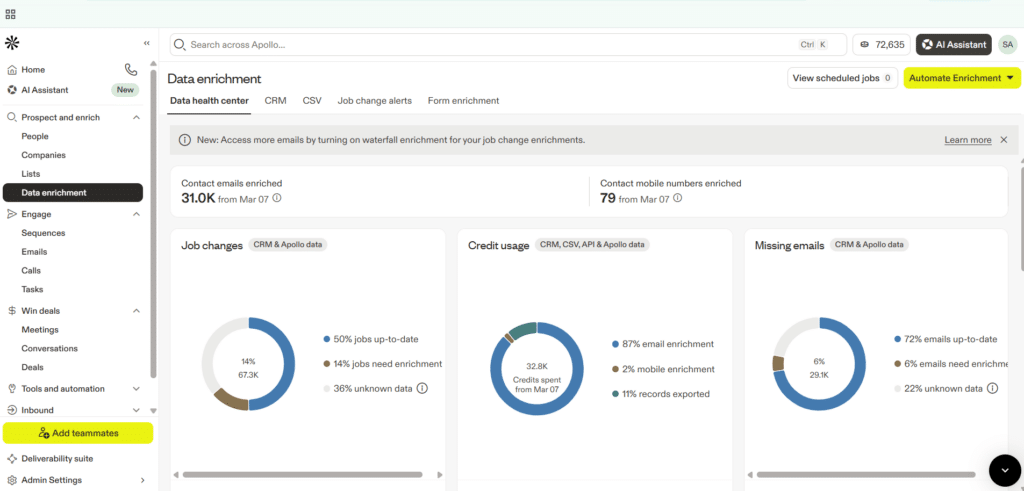
The Data health center screen shows two headline numbers at the top: Contact emails enriched (31.0K from a given date) and Contact mobile numbers enriched (79 from the same date). Below these, three donut charts break down coverage across the CRM: Job changes (50% jobs up-to-date, 14% need enrichment, 36% unknown), Credit usage (87% email enrichment, 2% mobile enrichment, 11% records exported, out of 32.8K credits spent), and Missing emails (72% emails up-to-date, 6% need enrichment, 22% unknown).
The tabs above this view — Data health center, CRM, CSV, Job change alerts, Form enrichment — indicate that enrichment in Apollo isn't limited to Apollo's own contact records. Teams can run the same enrichment logic against data synced from their CRM, against a CSV upload, or against form submissions captured on their own website.
Enrichment coverage isn't binary — Apollo splits it into up-to-date, needs enrichment, and unknown, and that middle-and-unknown split is where most CRMs quietly rot.
The 'unknown' segment is the one to watch
Most enrichment dashboards only report a pass/fail split — data is either enriched or it isn't. Apollo's three-way breakdown (up-to-date / needs enrichment / unknown) is more useful because 'unknown' is a distinct risk category: it means Apollo has not yet attempted or completed a lookup for that record, as opposed to having tried and failed.
In the reviewed screenshot, the Job changes chart shows 36% of records in the unknown bucket — more than double the 14% actively flagged as needing enrichment. A team relying only on the 'needs enrichment' number would significantly underestimate how much of its CRM has unverified job-title and employer data.
Job change alerts: catching champions before they leave
The dedicated 'Job change alerts' tab is one of Apollo's more strategically valuable enrichment features. When a known contact changes companies, Apollo can surface that move — which matters enormously for account-based sales motions where a champion moving to a new company represents both a risk (losing the relationship at the old account) and an opportunity (a warm lead at the new one).
Credit usage discipline
The Credit usage donut (32.8K credits spent, 87% on email enrichment) is a useful cost-control view for teams on a metered enrichment plan. Because email enrichment consumes the overwhelming majority of credits in this account, a sales ops leader reviewing this chart can quickly assess whether the team is enriching records indiscriminately (e.g., re-enriching contacts that are already up-to-date) versus targeting only the records flagged as stale.
Verdict
Apollo's Data enrichment health center turns an invisible problem — silent CRM decay — into a visible, trackable metric. The three-way up-to-date / needs-enrichment / unknown breakdown is more honest than a simple pass/fail indicator, and the dedicated job-change alerts tab adds strategic value beyond basic data hygiene.
For any sales team running outbound at scale, this dashboard is worth checking monthly at minimum — stale contact data is one of the quietest ways an otherwise well-run outbound motion loses efficiency.