The problem with post-call notes
Every team that runs a meaningful volume of inbound calls faces the same operational debt: post-call note-taking. An agent finishes a call and has to decide how much of the conversation to capture, where to put it, and how to phrase it so the next teammate who opens the record understands the context. The result is almost always inconsistent — some agents write three paragraphs, others write nothing.
Quo's AI call transcript feature eliminates the manual step entirely. The platform automatically transcribes every call, generates a plain-language summary with bullet-pointed key points and a 'Next steps' block, and saves everything inside the conversation thread so any teammate can review the full context before the next interaction.
Inside a live transcript: the Lisa Price example
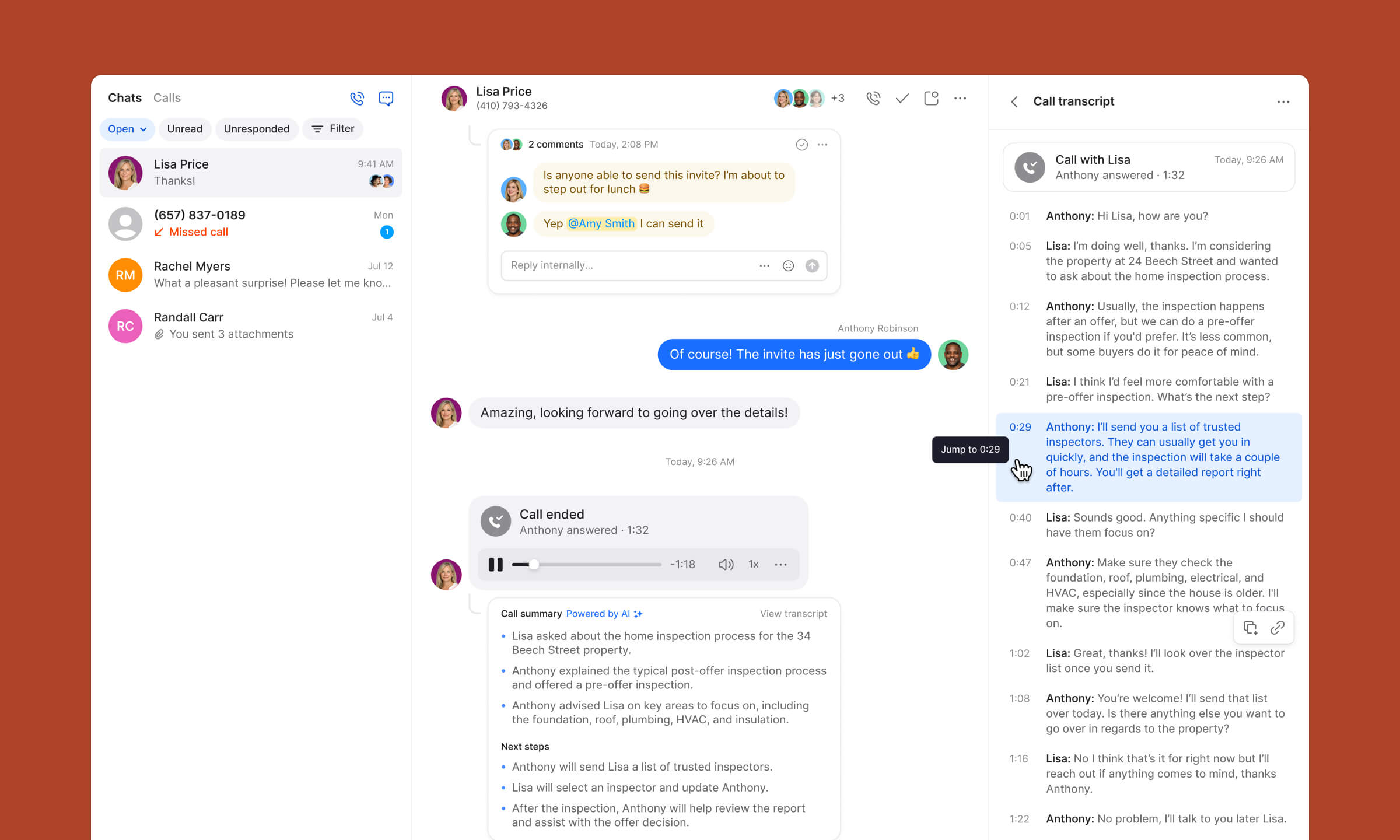
The transcript visible in Quo's conversation view shows a real estate scheduling call between Lisa Price and Anthony. The call lasted 1 minute and 32 seconds ('Call ended - Anthony answered 1:32'). The full transcript panel on the right side of the screen renders the conversation with speaker labels and timestamps — each exchange attributed to either the agent or the customer with a precise time offset.
The left panel shows the AI-generated output: a structured summary beginning with the call status followed by the call duration, then a bullet-pointed summary of the key discussion points, and a 'Next steps' section that captures action items. For this call, the summary notes that the conversation concerned a home inspection at 24 Beech Street, the parties agreed on a follow-up time, and specific logistical details were confirmed — all captured without the agent writing a single word.
1:32 call, full transcript, structured summary with next steps — captured automatically, zero manual effort from the agent.
How the AI summary is structured
Quo's AI summary follows a consistent template across all calls. The header shows the call status (completed, missed, voicemail) and duration. The body is a bulleted list of the main discussion points in the order they arose — not a paraphrase of the full transcript, but a distillation of the decisions, requests, and information exchanges that will matter for follow-up. The 'Next steps' block is a separate section that extracts only the action items: what needs to happen, by whom, and (if mentioned) by when.
This structure is important because it serves two different readers: the original agent who needs a quick memory-refresh before a follow-up call, and a covering teammate who is picking up a conversation cold. Both readers get exactly what they need without scrolling through a full transcript.
The full transcript panel: when you need the verbatim record
The full transcript panel is accessible with a single click alongside the AI summary. Speaker labels are color-coded and each utterance is timestamped, making it straightforward to locate a specific moment in the conversation — useful for dispute resolution, compliance review, or coaching sessions where a manager needs to reference an exact exchange.
The transcript is stored persistently in the customer thread, searchable by keyword. A team that fields ten calls per day with a single agent would accumulate roughly 200 searchable transcripts per month — a growing knowledge base of real customer language, objections, and questions that can inform training, product feedback, and FAQ content.
Privacy, consent, and disclosure considerations
Call transcription and AI summarization raise legitimate questions about consent and data handling. Quo records calls in accordance with platform-level settings that teams configure during setup. Most jurisdictions that require two-party consent for call recording also require audible or verbal disclosure at the start of the call. Teams using Quo's AI transcript feature should confirm their disclosure settings and, where required by law, ensure their call greeting includes a recording notice.
From a data handling perspective, transcripts are stored within the Quo workspace and are accessible only to credentialed team members. Managers should review Quo's data retention policy and confirm that transcript storage aligns with their industry's record-keeping and privacy requirements before enabling the feature at scale.
Verdict
Quo's AI call transcript and summary feature delivers on the promise that appears in the platform's marketing: it genuinely removes post-call note-taking from the agent's workflow. The combination of structured summary (decision-focused) and full verbatim transcript (verification-focused) covers the full range of use cases from quick follow-up prep to compliance review.
For teams where call documentation is currently inconsistent or non-existent, this is the feature most likely to create an immediate, measurable improvement in handoff quality and customer experience. Combined with the Analytics dashboard and the call log filter, Quo's AI transcript closes the loop between what happened on a call and what the team does next.
The AI transcript closes the loop between what happened on a call and what the team does next — that is where the operational value lives.